Dawn Seed
Pilot

Your job: shape the organization. Start by making visible
what is there today.

For everyone who has the job and is still working out where to start.

Dawn Seed shows how your organization works today, from a single board to how the departments work together, and guides you step by step as you shape it: with a well-grounded concept, an app, an AI assistant that knows your organization, and in a pilot with me.

Book an intro call

5 pilot spots starting in November, each with a weekly call with me.

EU-sovereign: language models can run entirely in the EU, if you choose

Animation: cards move between three levels of an organization, from strategy through coordination down to operational work.

By the time the target is described, it has already moved.

Drawing a finished target picture of the organization usually takes longer than the target holds still. What companies need now is the ability to keep evolving their operating model: as a practice you keep up continuously, with changes that no longer hurt as much. AI helps with that, already on the way there.

What it’s about

Organizational development is often seen as black magic: a lot of gut feeling and little you can put your hands on. Just as often, it shrinks down to a new org chart. Neither does justice to the work that actually needs doing.

At its core, it comes down to three questions, put simply:

  1. How do we line up? The structure: departments, teams, work systems.
  2. Who is on the field? The people and their roles.
  3. How do we play the game? How work flows through the organization and where decisions are made.

The right people in fitting structures, with ways of working that hold up: that is the operating model. Business model and strategy set the direction. Dawn Seed comes in where this turns into the everyday life of the organization, in how it is set up as much as in how work flows.

Six views of one organization

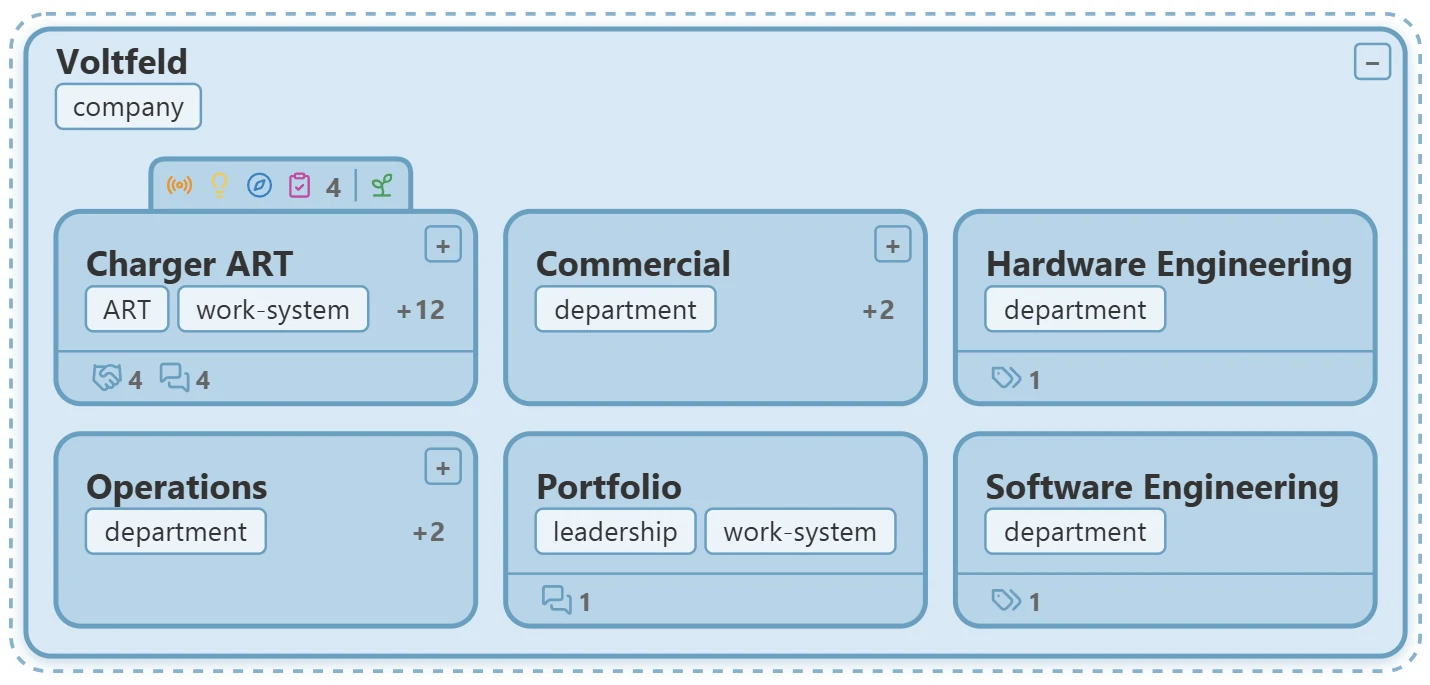
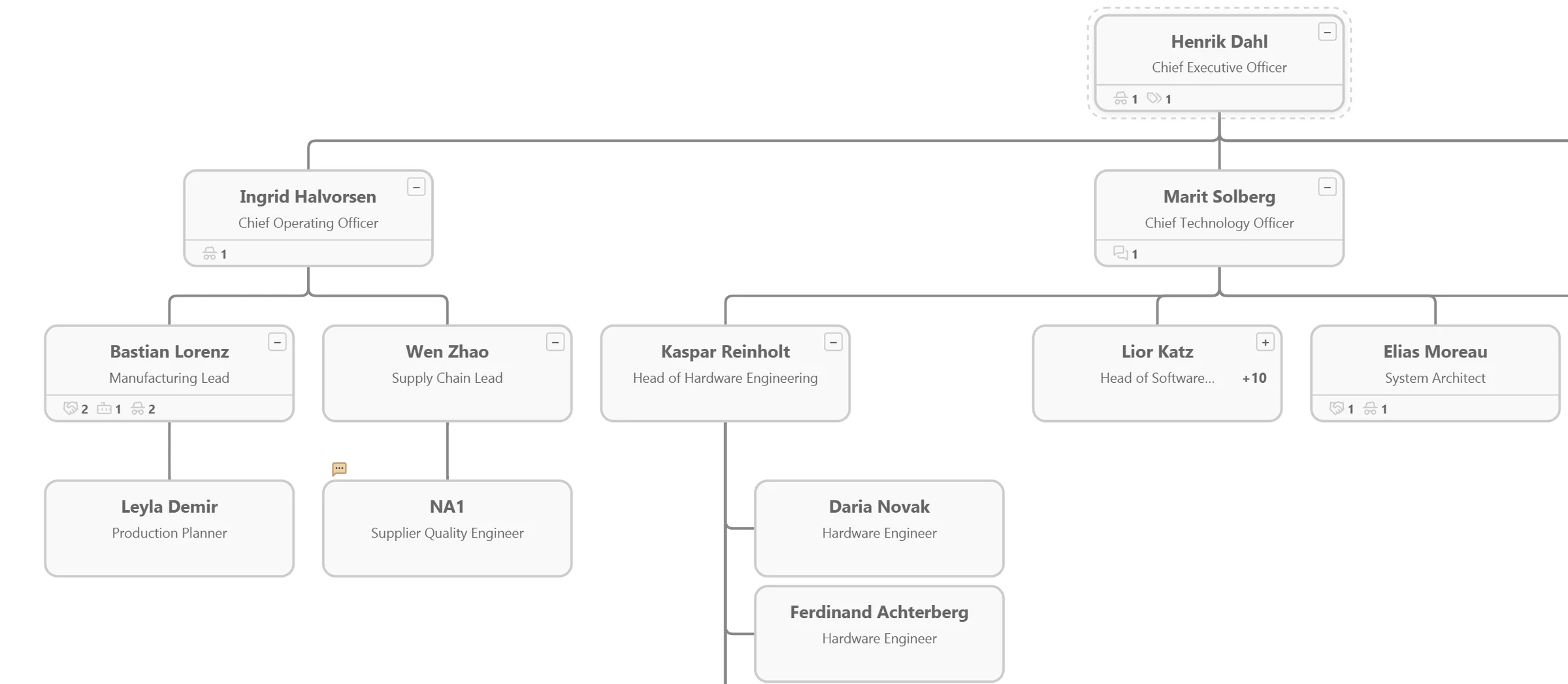
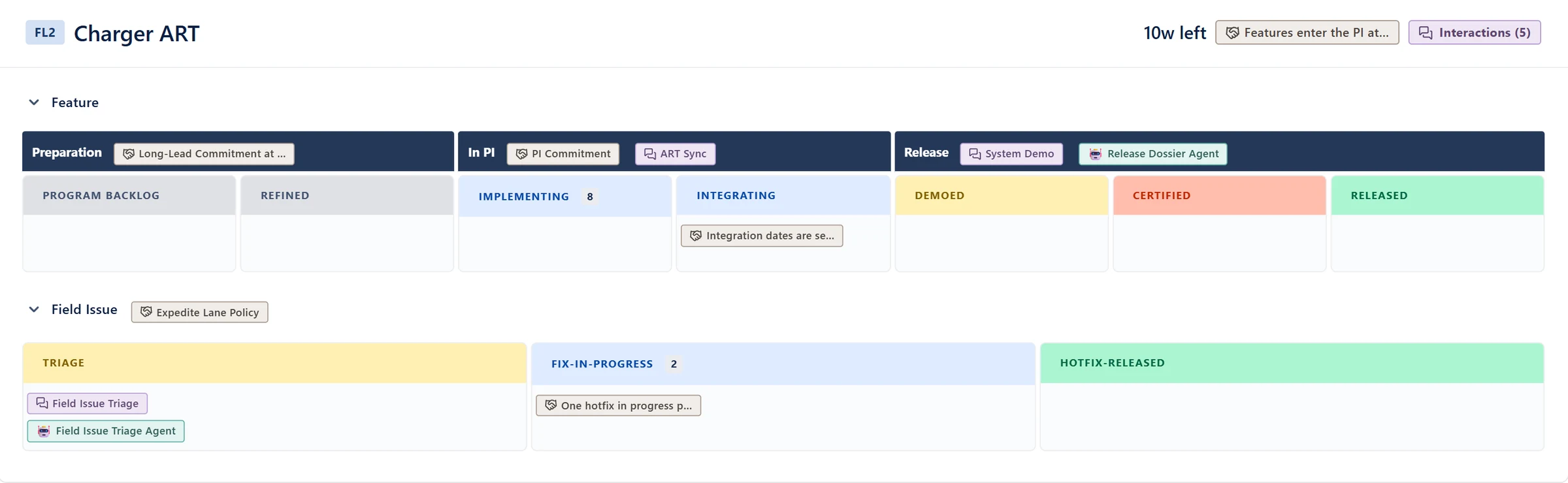
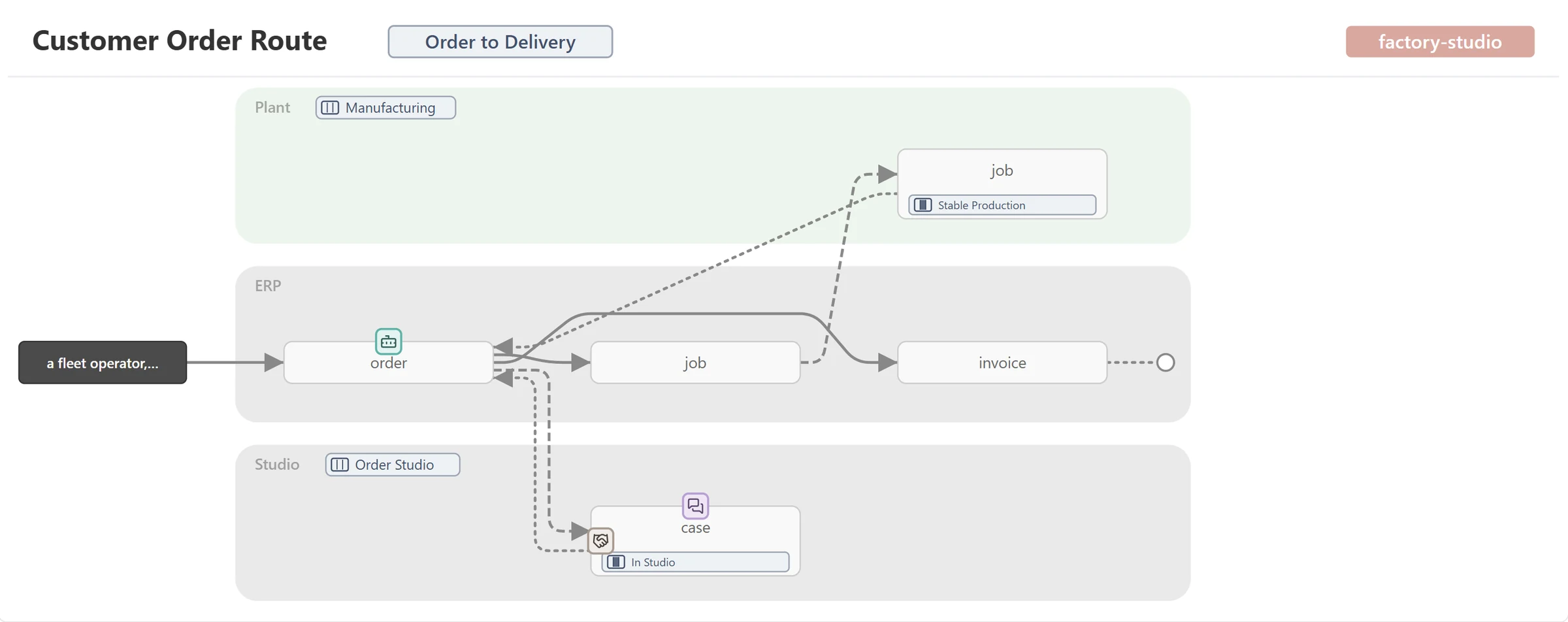
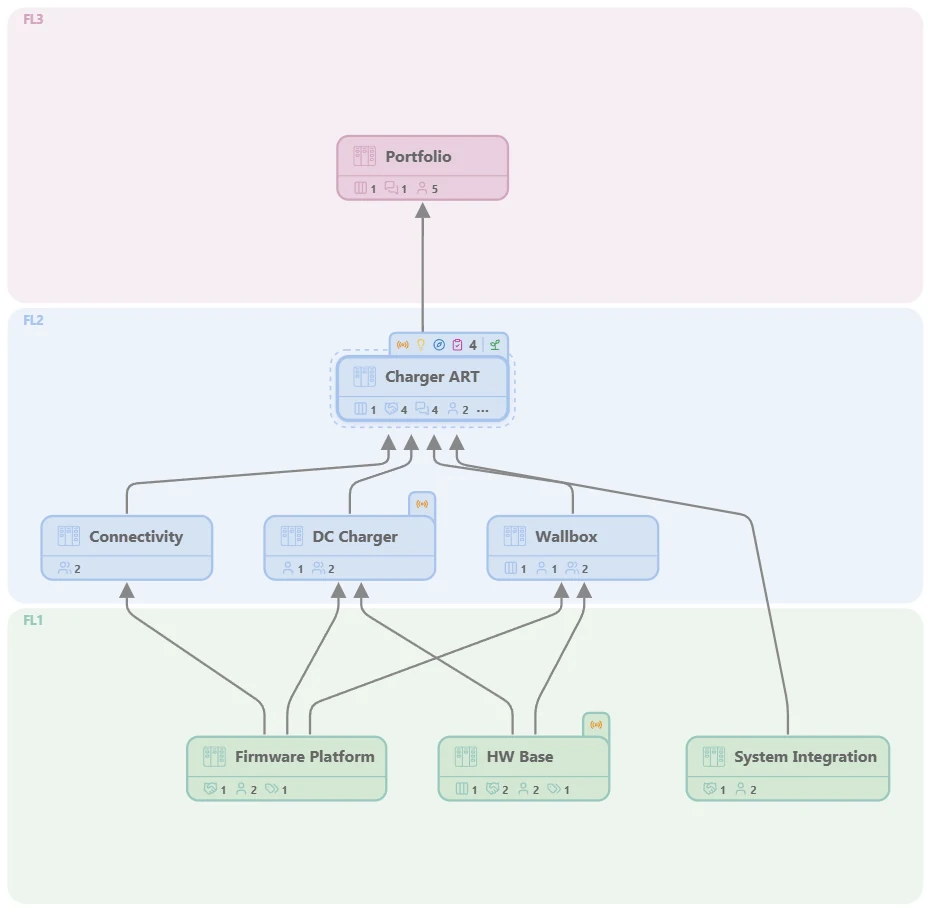
Voltfeld, a maker of charging stations, is the example organization in Dawn Seed. Here you see it in the six views the app draws today. Units and org chart show how it is set up; board, flight route and topology show how work flows. Agreements, meetings and AI agents sit right on these visualizations. The sixth view shows how the pieces point to each other.

Maps that people and AI agents can find their way around

Organizations are complex, and they stay that way. To find your way through them and shape them, you need better maps of the organization. These are made so that people and AI agents get their bearings on the same map, without oversimplifying and without over-structuring.

What you do with Dawn Seed

In the app you work with the same visualizations as above, together with AI agents that find their way around them just as you do.

What-if scenario for the Goldcrust bakery (labels in German): phone orders marked red, delivery yellow, a new online orders team green.
  • red goes away
  • yellow changes
  • green is added

What-if scenarios: play through options before anything changes

You sketch an option right on the map and see what goes away, what changes and what is added. Agents work it through with you: Which flight route runs differently then, which team gets more work, which agreement no longer fits? Several scenarios sit side by side until you decide.

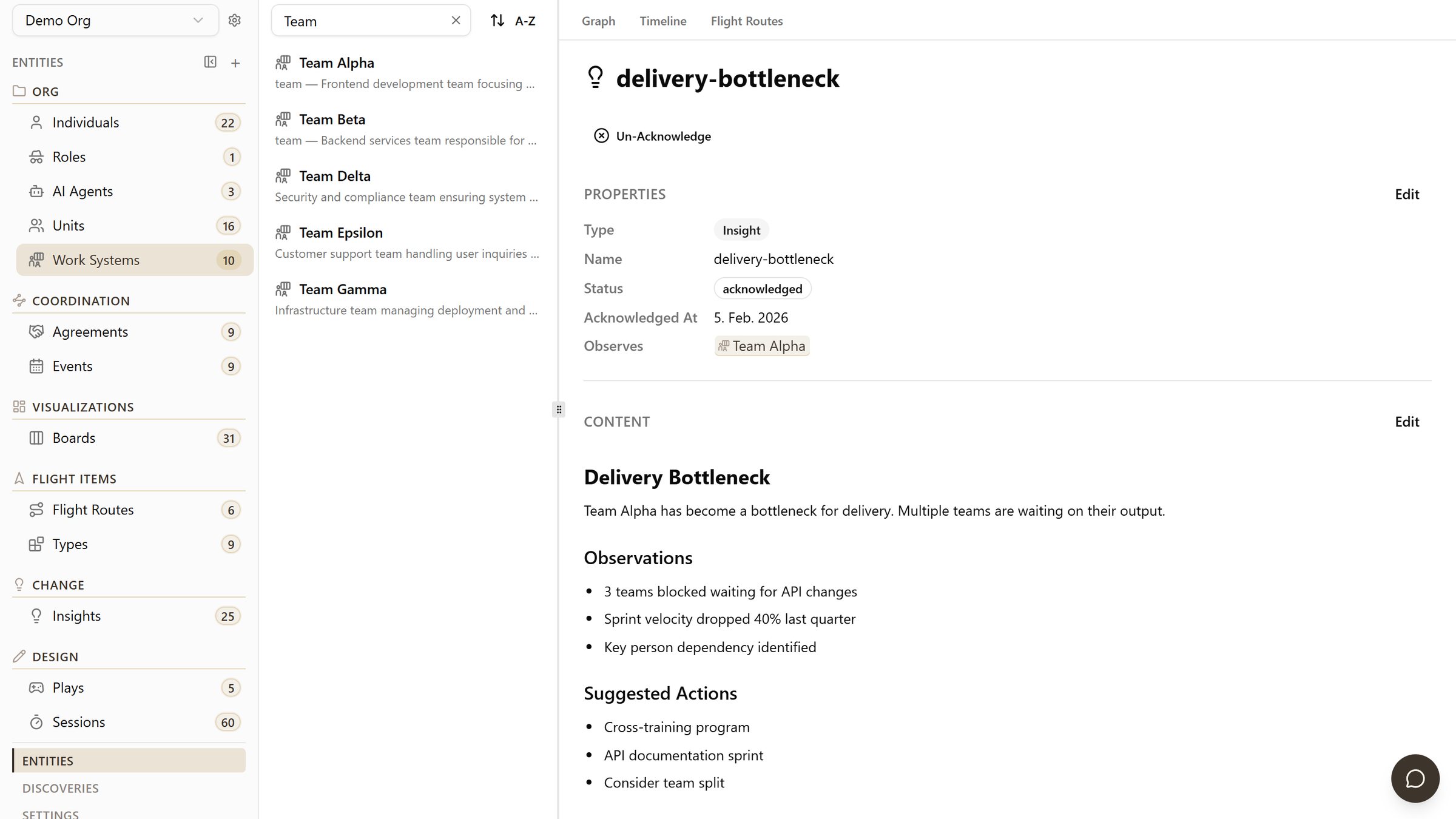
An observation in Dawn Seed attached to Team Alpha: three teams are waiting on API changes, velocity dropped by 40 percent last quarter, a dependency on one key person. Below it, suggestions for what could be done.
An observation on Team Alpha: who is waiting, what has changed, and what could be done.

Pin decisions where they take effect

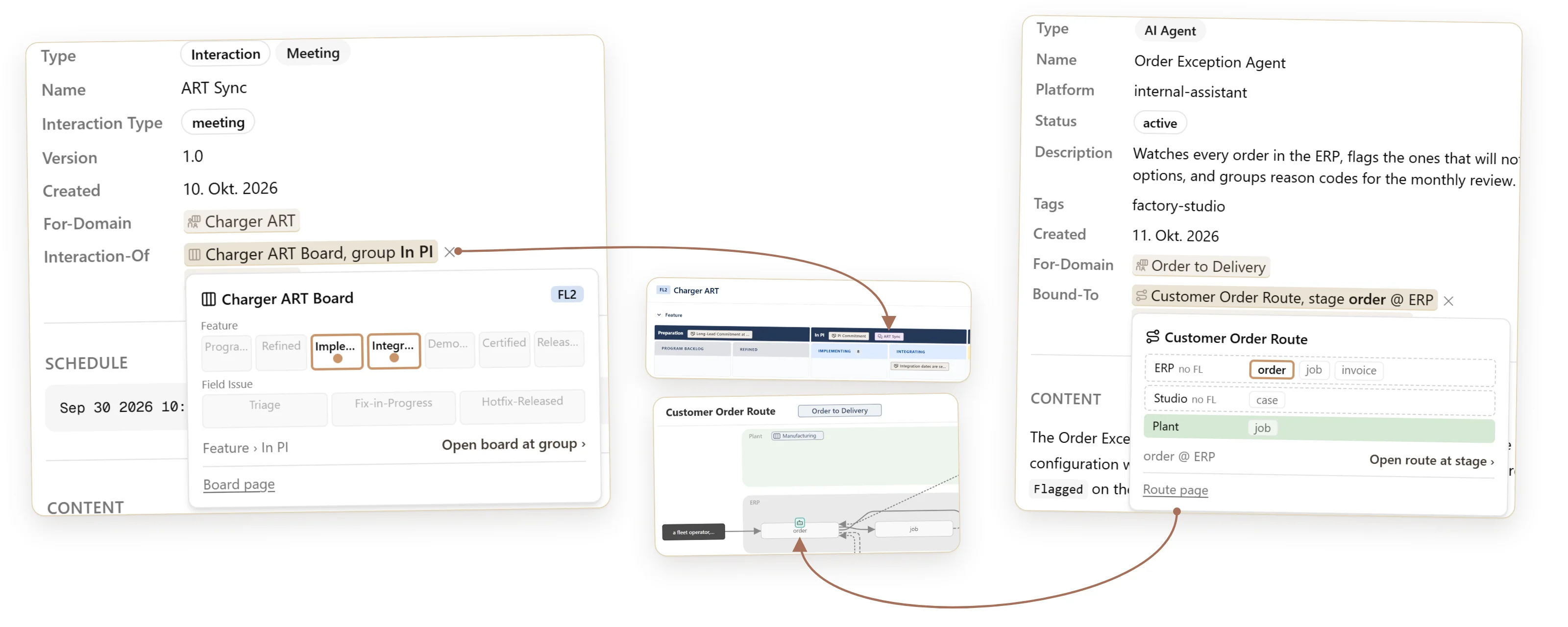
What you notice and what you decide is attached to the place it concerns: a team, a board, a role. That way everyone sees where things are stuck and why something is the way it is, and the agents see it too.

Designing with Frankly

If the goal is an AI-native organization, the way there can now be AI-augmented too.

Frankly is the AI assistant in Dawn Seed, and it knows your organization. It walks through it with you, plays through options with you and, if you like, facilitates a workshop step by step until you reach a decision together.

Ask the map

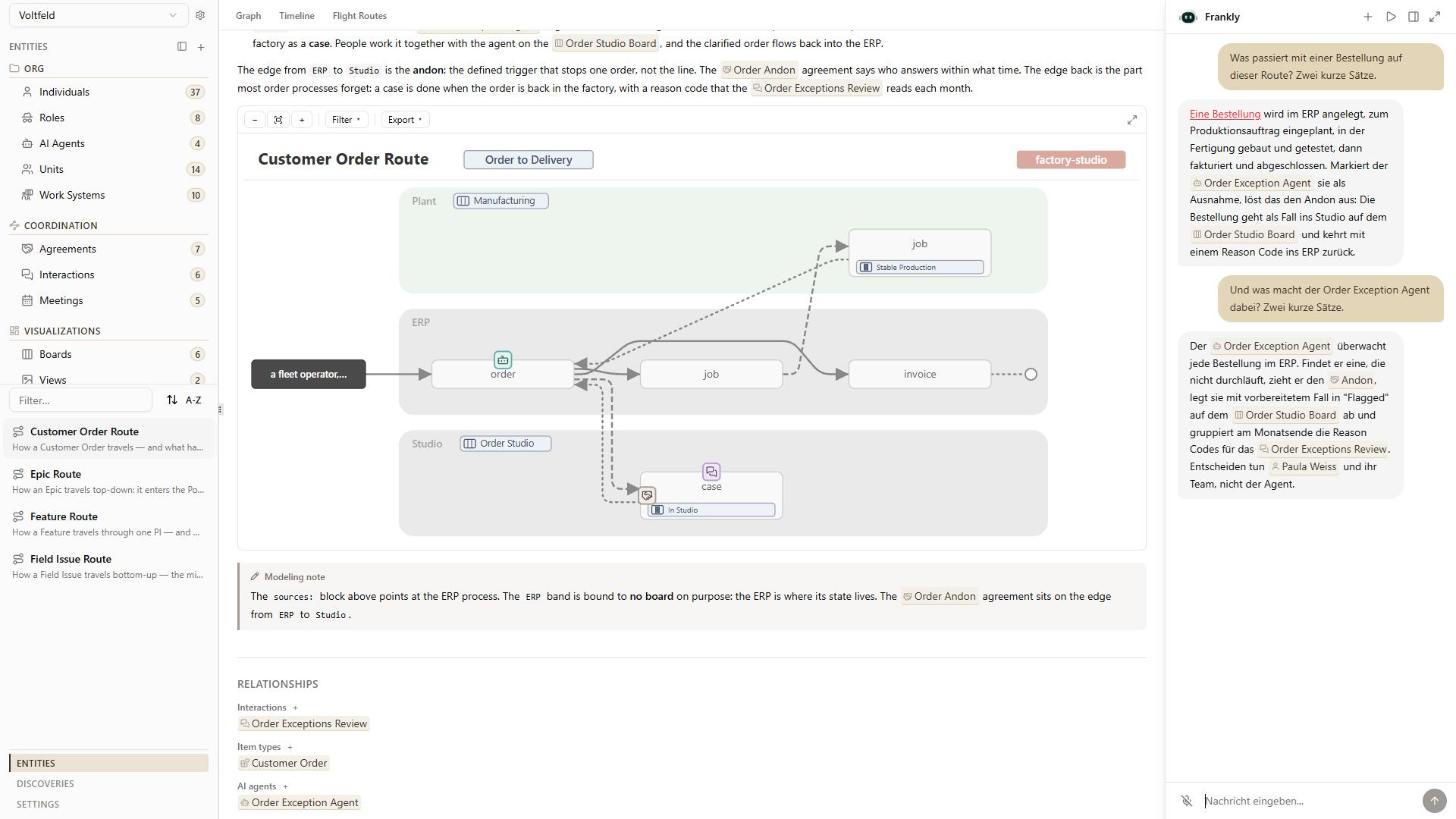
What happens to an order on this route? Frankly answers from within your organization: which stages, which teams, which agreements apply.

Agents with a set place

An AI agent works at a specific stage, and everyone can see what it does. You and your team decide. Frankly makes sure you see more while you do.

Dawn Seed showing the flight route of a customer order across the bands Plant, ERP and Studio, with an AI agent at one stage. On the right, Frankly explains in the chat what happens to an order on this route and what the Order Exception Agent does.
Frankly explains a flight route with an AI agent at its ERP stage: what happens to an order and what the agent does along the way.

The concept behind it

Change as a practice. On the inside, you think in mental models: what makes up an organization. In the middle are the five steps you use to change it, as a loop. On the outside, you work hands-on, in Dawn Seed. In every step, AI agents work alongside you, and they know their way around the maps of your organization.

Change as a practice A circle with three rings. Inside, the Star Model: strategy; below it people, structure, rewards and processes; from these, behavior, performance and culture. In the middle, the steps Define, Map, Assess, Design, Elevate as a loop. Outside, highlighted, the results you work with in Dawn Seed. Starting point Goals or pain point Define Org model Work Systems Topology Flight Routes Boards Org Graph Map Change conversation Signal → Insight → Driver Assess Change conversation Proposal → ODR → Agreement Design Work Change with the people Elevate Strategy People Structure Rewards Processes Behavior Performance · Culture What do we want to achieve? What becomes possible? What is needed now? Pain points where things no longer fit Inside: thinking in mental models Outside: working hands-on in Dawn Seed Sources: Star Model (Jay Galbraith) · MADE (Org Topologies™: Krivitsky, Larman, Flemm) · Flight Levels
  1. Define

    You clarify what you want to achieve or what is bothering you right now, and who should have a say.

    AIFrankly facilitates a round in which you clarify this together, and captures the goals and the reason in a few sentences.

  2. Map

    You map how your organization works today: teams, boards, flight routes, roles, agreements.

    AIAgents compare this with your existing systems so you don’t start from zero; we set up that connection together in the pilot. Then they help sort what they find, enrich it and turn it into maps of your organization.

  3. Assess

    You take time for what you notice, pin it to the place it concerns, and turn it into a reason for change.

    AIAgents hold this change conversation with you. In the future, they will also keep looking at your model with a specific question in mind and make visible what is building up before it hurts.

  4. Design

    You design a change and record the decision with its reasoning.

    AIAgents play through what-if scenarios with you and show what an option sets off elsewhere.

  5. Elevate

    You put the change into practice with the people it affects, visible to everyone. How the changes flow back into your tools for collaboration, coordination and communication is something we set up together in the pilot.

    AIAgents accompany the change step by step, keep the goals in view and show whether it works. That starts the next round.

Behind it is Dynamic Work Systems Design, an approach that builds on Flight Levels, Org Topologies™ and more. The language Dawn Seed uses to describe your organization is called DWSD, and it is openly documented at dwsd.md.

Sound familiar?

The topic is big, the starting point unclear, and the organization itself is hardly visible. That is why many people who have the job hesitate. Three situations I come across again and again:

The new AI adoption lead

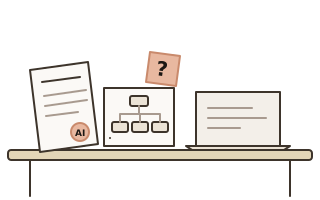
She has been in charge of AI adoption for three months. On her desk: the mandate from senior management, a list of tool requests from the departments, and an org chart that stopped being accurate a while ago. She wonders which area to start with and who all of this affects.
The CTO with an AI strategy

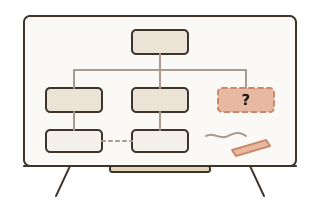
Last week he presented the AI strategy to the leadership team. Now he is standing at the whiteboard, sketching his teams and wondering whether to hire for it or build it with the teams he has. How the teams actually work together today, he only roughly knows.

The managing director of a mid-sized company

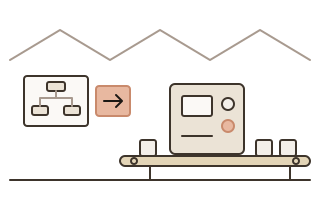
She runs a family business with a strong manufacturing side. The technology is moving faster than the organization around it, and the shop floor feels it first. She wants to change something without rebuilding the whole house at once, and she is looking for the first lever.

Take it with you

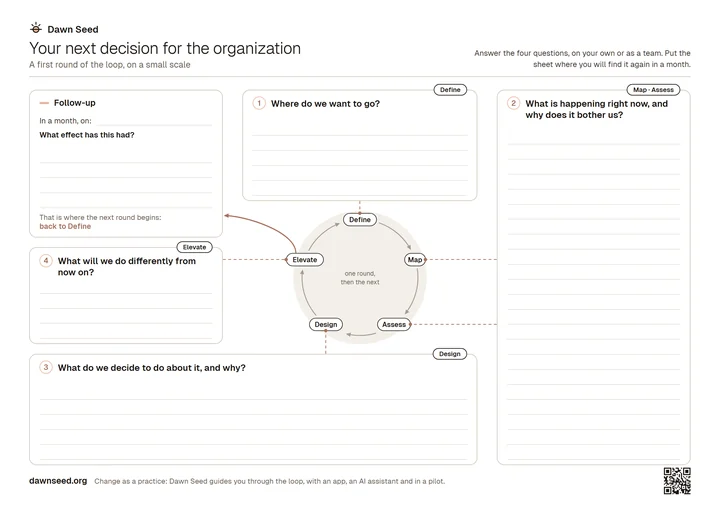
A first round of the loop, on a small scale: your next decision for the organization, in four questions.

  1. Where do we want to go?
  2. What is happening right now, and why does it bother us?
  3. What do we decide to do about it, and why?
  4. What will we do differently from now on?

As a sheet to print (A4, PDF)

Write down the answers and put them where you will find them again in a month. Then ask: What effect has this had? That is where the next round begins.

How a pilot works

  1. A conversation about your job

    90 minutes. You describe what you want to achieve, and I suggest a slice of the organization to start with: one area, one product line or one site.

  2. Your slice in Dawn Seed

    I map the slice in Dawn Seed with you and capture what you want to achieve. After that, you see your organization the way it is today.

  3. One step every week

    In the weekly call, you and I look at what stands out, play through what-if scenarios and carry out the next step. Between calls, Frankly supports you in the app.

5 pilot spots starting in November. No more. Because I accompany every pilot personally. Write me two sentences about your job, and I will get back to you with a suggested date.

I only use your details to get back to you about the intro call. Processed via MailerLite, details in the privacy policy.

Your organization belongs to you

Everything we map in Dawn Seed stays with you as plain text files: the views of your organization, observations, decisions. You can read them, version them and take them with you at any time, also after the pilot and without Dawn Seed.

Portrait of Thomas Krause

Who is behind it

I’m Thomas Krause, a work systems designer from Karlsruhe, Germany. I help organizations evolve and connect their strategy with their daily work. For me, much of that is a practice. Dawn Seed is the tool I use for this work myself, and now you and your team can use it too. In the pilot we work on it together until you use Dawn Seed on your own.